
The pressure to get a child to sit down and study can feel like a constant struggle. We push them to concentrate, to read chapters, and memorize facts, believing that this kind of serious, focused effort is the only path to success. We often treat "playtime" as a reward or a distraction—something to be earned only after the "real learning" is done.
But what if this entire approach is fundamentally backward? What if science tells us that play isn't a distraction from learning, but the most powerful form of it?
The problem is that we, as parents, often view play as the opposite of education. We see it as fun but frivolous. In reality, forcing a child to learn through rote memorization is like asking a fish to climb a tree. It goes against their very nature. Children are biologically wired to learn through exploration, curiosity, and play.
The Solution: Learning That Feels Like Play
Decades of research in neuroscience and child psychology have shown that for a child's developing brain, playing isn't just a break. Playing is the brain's favorite way to learn.
Here’s the simple science behind it:
-
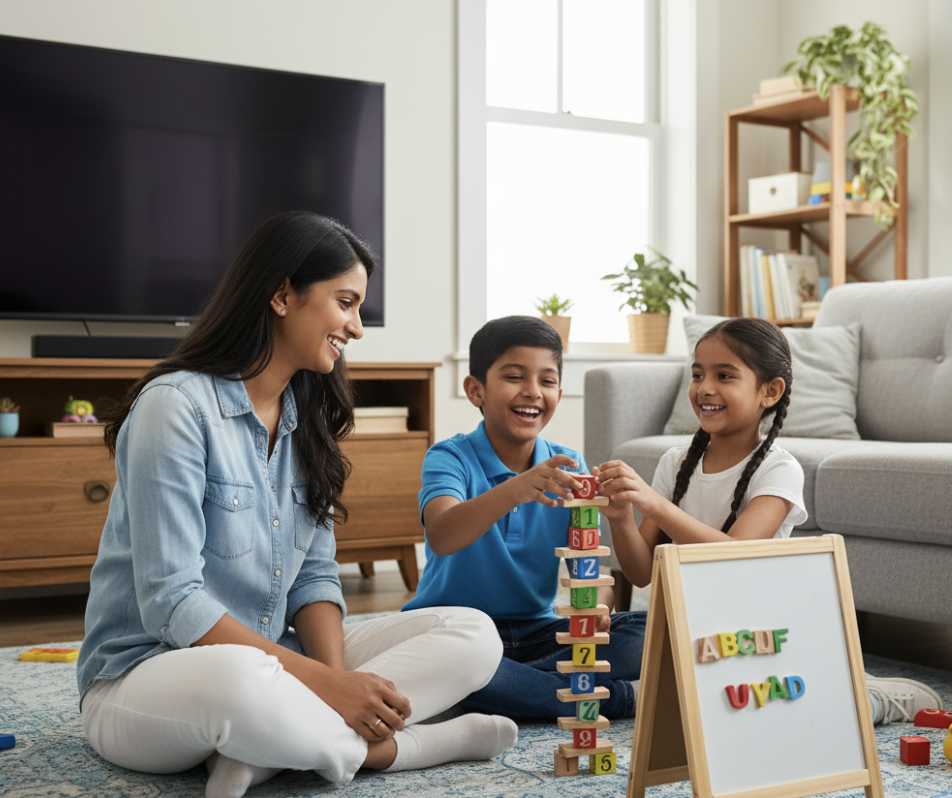
Play Builds a Better Brain: When a child builds with blocks, they are actively learning about gravity, balance, and geometry. When they run and chase friends, they develop spatial awareness and coordination. Each act of play creates and strengthens vital neural connections, making their brain faster and more flexible. It’s a literal workout for their brain cells.
-
Play Teaches Real-World Problem Solving: In a made-up game, children have to create rules, communicate them, and adapt when things go wrong. This is the foundation of creativity and critical thinking. They learn to negotiate and solve problems on their feet—skills that no exam can measure but are essential for success in life.
-
Play Develops Emotional Intelligence: When a child has to share a toy, they learn about empathy and fairness. When they lose a board game, they learn how to manage disappointment. Playing with others teaches them how to read social cues and work as a team. These are the "soft skills" that help them build friendships and become well-adjusted adults.
Information sticks when it’s linked to a positive emotion. A child struggling to revise a tough concept can master it effortlessly when it’s part of a fun game, because the learning is connected to joy and a real-world context.
Unlock Your Child’s Potential with Joyful Learning
As parents, our biggest job is to nurture our child's natural curiosity, not extinguish it with pressure. The most effective learning happens when a child is engaged, happy, and genuinely interested.
We know it's not easy to do this alone, especially with complex subjects.
That's where we come in. At Paathshala, we believe that learning should never feel like a chore. Our tutors are experts at transforming tough subjects into exciting challenges. They use play-based methods, interactive storytelling, and real-world examples to make learning stick. They don't just teach the syllabus; they bring it to life.
End the daily study struggle. Let us help you bring the joy back into learning.